Posted on April 24, 2009

Honoliuliu Trail.

Honoliuliu Trail.

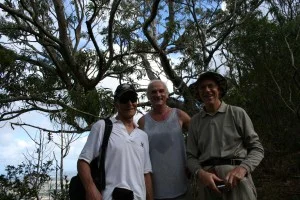
A day up the Honoliuliu trail  along the Waianae mountains with my brother- in- law Ralph Morelli, computer science professor at Trinity College, CT, and author of Java, Java, Java, Object-Orientated Problem solving, and Duane B. former researcher, Dept. of Tropical Plant and  Soil science, University of Hawaii at Manoa and myself.


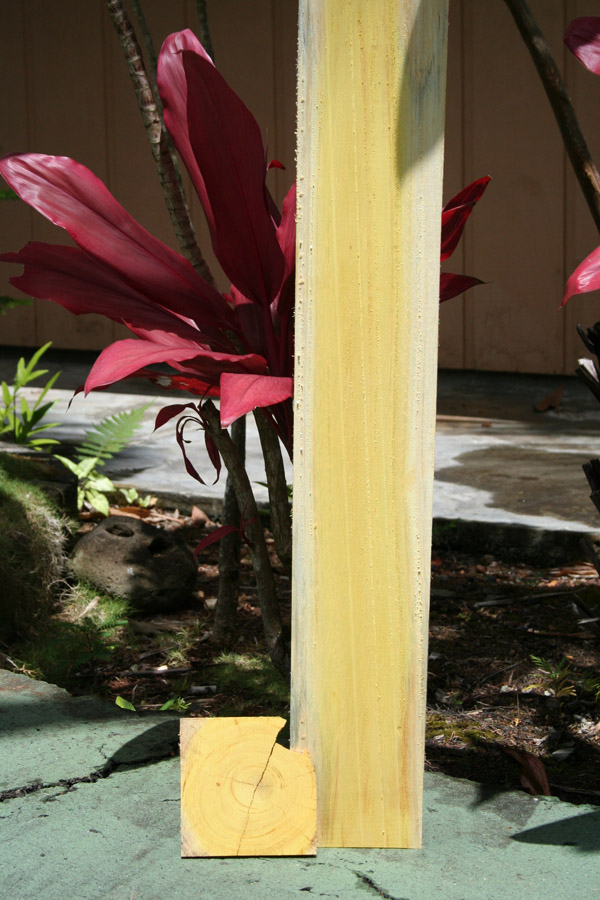
The most common trees along that trail are species of Eucalyptus, a lot of Silky Oak,

also called Lacewood, and curiously enough a few Bunya Bunya trees, a conifer specie

closely allied to pines, redwoods and other primitive trees. Queensland, Australia, is

the tree native land.  Once prized in Hawaii, its wood was used for ship’s masts and spars.


Posted on April 19, 2009

I do not believe in gambling or in the stock market…well maybe yes if I would have money to burn.

But I truly believe that there are treasures out there for one to scoop up, provided one

is knowledgeable in the field in question, and keeps his eyes and ears wide open.

In my time studying the canoes of Oceania I also gain knowledge about the culture

and traditions of the people building those vessels.

So when visiting an antic shop on Oahu a few days ago my eyes were immediately

attracted by a dark stained wooden mask lying on a chair. I took the mask in my hands

and realized immediately that this is an old mask, and not a contemporary sculpted one.

I asked how much? Well, I’ll give it to you for $ 20.00 said the shop keeper. I handed

her the money.

I knew of course that the mask in question is an old Asmat ceremonial mask dating to

1930-40, and therefore extremely valuable. The Asmat tribe is notorious for head-hunting, residing in West-Papua (Irian Jaya).

The Asmat people are considered the best wood carver of the stone age, creating intricately carved canoes, including model canoes that they

offer to their ancestors. Important collections of Asmat Art are located at the Ethnographic Museum of Heidelberg, Basel and Neufchatel.

Old Asmat Ceremonial Mask, Papua New Guinea

Old Asmat Ceremonial Mask, Papua New Guinea


Posted on April 14, 2009

It happens frequently, when surfing online about canoes, amongst others Hawaiian voyaging, surfing or racing canoes, that I come across websites using the picture of one of my earlier Hokule’a  model as an attention getter. 
Some companies or webmasters asked permission to publish that picture on their site, others did not.
This scale model of the Hokule’a is one of my creations and it belongs to a private collection .
I am not aware that it is for sale at any art galleries on the islands of Hawaii.                                                                                               


Posted on April 12, 2009

Courtesy of Honolulu Star-Bulletin

Courtesy of Honolulu Star-Bulletin

I am referring here to an article written by Gregg K. Kakesako in the Honolulu Star-Bulletin of Friday March 20/09 .


titled  < Kokule’a hits Palmyra, gets new crew members >.

The article was illustrated with a photo of the Hokule’a under full sail near the atoll.

What was so unusual in this photo was the fact that the voyaging canoe was equipped with a set of triangular staysails, one set forward of the foremost mast, the other in between the two crab claw sails.

Although I understand that smaller jibs increase the speed of the craft in high wind

conditions , it needs to be said however that no traditional Oceanic voyaging canoe was

ever rigged in such a manner. Thus , the rigging as shown in the attached picture, departs

from what is known about Hawaiian voyaging canoes.


Posted on April 11, 2009

Was it writers block or busy doing other things? I believe it’s a bit of both.

Anyway I am back on the block after a sabbatical lasting a few months.

I really like this word “sabbatical” as it translates with “Forshungsurlaub”

in German, which really means a vacation of studies and research !Well, this is

exactly what I have been up to ever since bailing out the water from my flooded

workshop.

Never short of work been commissioned to build model canoes of Oceania, I

also spent much time and effort building up my photo albums on Flickr.com and

Picasa.com. Both albums are similar in content and run under the username <hawaiiancanoes> Most recent photos do illustrate 2 very beautiful surfing canoes

and a Samoan one man fishing canoe been auctioned at Niketown in Waikiki.

The Hawaiian canoes were quite old, carved out of Koa tree logs.


Posted on December 15, 2008

If living in Hawaii is a dream for many, dealing with flash floods and landslides is not what most people think about our islands.

It all happened very fast, just a few days ago on December 11th at 5.30 AM.

The heavens opened up to torrential rain causing extensive flash flooding and a landslide

just on top of my property.  Within minutes a river of mud, rocks and other detritus run

into my sloppy backyard and towards my front gate. I did not realize that the mud and branches will get stuck at the gate and therefore stop the proper flow of the mud and water. The water level rose so fast that in no time it runs into my workshop, flooding machinery, lumber, templates etc.

Towards 10.oo PM the rain stopped and it is only than that the extend of the damage

caused by the flash flood became apparent to me. My yard was filled with 2 feet of mud.

my pick-up truck was stuck in the mud, so was another car, my drive-way was busted

and the roots of a gigantic Albizia tree were laid bare.

First thing first, I immediately started to pump out the one foot of water that had flooded

my workshop and installed fans and heaters to dry some motors . But clearing the mud and rocks will take days. I guess that at the rate of 2 hours a day this will be a good and

cost free workout. Want to join ?

Flooded table saw, planer etc.

Flooded table saw, planer etc.


Posted on December 10, 2008

The reason for my long absence writing on my blog was due to me upgrading my website

and starting work on my Flickr and Picasa photos albums. Both the Flickr and the Picasa albums  run under the username “hawaiiancanoes”. The entire process of tending to those 3 sites at the same time while still carrying on building models was taking the better of a 3 months period during which I had to sort out literally thousands of pictures and write tens of captions. Some people who want to create a website complain of the lack of professional photos to embellish or illustrate their site. I had fantastic pictures, but before I could make use of them I had to sort them out and file them according to subject matter. So here I was, creating sets and albums with piles of  photos before I could create sets and albums on Flickr.  As for the caption to the images on the website or Flickr, some were easy to write while others required me to dig into nautical dictionaries to find out again what is the maritime word for “ steps” on a ship. I have to admit that writing good captions is a difficult exercise. All this work led me to forgo my yearly participation at the 2008 Hawaiian Juried Woodshow, but I tried somehow to make up for my absence to

this art show by illustrating the exhibited work of my colleagues on Flickr.

There are still bugs to be sorted out on my website and photos to be added on Flickr,

the work is never finished, but at least, for now, I can start spending most of my time

researching and building canoes that have sailed on all the corners of the Pacific.


Posted on September 5, 2008

img_2007a.jpgWhat happen with my 28″ Hawaiian double hull voyaging canoe you may ask ?
Well I had to make a new sail and finished the rigging by August.. A few days later
the canoe was sold and sailing, or rather shipped, to a collector on the mainland.
And here I am again, thinking about a more efficient, more hydrodynamic racing canoe..


Posted on August 4, 2008

img_1976a.jpgTen days have gone by since writing my last post. The building of the 28 inch double hull canoe I had designed a few days ago was finished yesterday August 2nd with the rigging being the remaining task to be done.
I was near to mount the sail today would it not have been for a moment of inattention.
Indeed I had spend several hours crafting the sail when, within a fraction of a second everything went to waste. In wanting to clean the sail I somehow lifted one corner of it
to fast and it broke. That was the end of that. I will have to make a new sail tomorrow.
Otherwise I am very satisfied with the canoe. I used highly figured Koa for the bow and
stern tops as well as for the stacked up rims.


Posted on July 24, 2008

img_1955.JPG

The entire day I was occupied in finishing a Salomon Island war canoe, the famous
“Tomako” used to go hunting for ‘heads”. But this model has been commissioned to serve as a gift to be offered to a famous author about Pacific history and culture .I am posting here a picture of the prow
ornaments of the canoe but further details can be seen in my Flickr.com album “Hawaiiancanoes”. I have a special liking for the Salomon Islands canoes. Indeed
I find them to be some of the most gracious canoes ever built in the South Pacific.
Ingeniously plank built, rather than carved, the prow and stern of those war canoes
are exceptionally tall and beautifully decorated with shells and feathers, as well as
with the famous nguzu-nguzu figure. Another type of canoe very similar to the
Tomako, and plank built as well, is the Filipino banca (boat) from Lake Taal.
If their hull shape and impressive prow and stern looks very much alike the Tomaka,
they differ however in that the Tomako has no beams and floats whereby the Filipino
banca is invariably equipped with a set of 2 double outriggers, sometimes 3 for the
larger bancas. And again, there is a further type of canoe whose hull shape and construction is remarkably similar to the two previous ones, and this is the Perahu
katir from Java.
After spending most of the day on the Tomako model, I hurried to draw the lines
for the 2 hulls of the voyaging canoe as viewed from top. Without that set of line
drawings I would not be able to calculate the height of the beams nor have a proper
idea regarding the shape and width of the beams.


Older Posts